
Organization of treatment and rehabilitation in Germany.
Complete medical support.
Complete medical support.



+49 176 17917001
All departments
Impingement syndrome (subacromial impingement) involves rotator cuff tendon and subacromial bursa entrapment between the humeral head and acromion during arm elevation. It is the most common cause of shoulder pain — up to 65% of all shoulder consultations. Without treatment, impingement leads to chronic inflammation, tendinopathy, and rotator cuff tear. Treatment in Germany includes precise diagnostics, physiotherapy, innovative regenerative therapy for tendon regeneration, and when necessary — arthroscopic decompression.
The shoulder is the body's most mobile joint, stabilized by the rotator cuff — four muscles and tendons (supraspinatus, infraspinatus, teres minor, subscapularis). Between the cuff and acromion sits the subacromial bursa — a "cushion" reducing friction. In impingement, the space narrows and tendons/bursa become trapped during arm elevation. Repeated mechanical irritation causes inflammation (bursitis), tendon degeneration (tendinopathy), and ultimately — cuff tear.
Anatomical causes include hooked acromion shape (Bigliani type III) and acromioclavicular joint osteophytes. Functional causes involve humeral head depressor weakness (infraspinatus, subscapularis), muscle imbalance, and shoulder instability. Degenerative causes include age-related bursal thickening and tendon calcification. Overload from repetitive overhead movements affects swimmers, tennis players, volleyball players, painters, and construction workers. Post-traumatic causes follow greater tuberosity fractures and shoulder dislocations.
| Stage | Age | Changes | Treatment |
|---|---|---|---|
| I | <25 yrs | Tendon edema and hemorrhage. Reversible | Conservative, regenerative therapy |
| II | 25–40 yrs | Fibrosis, tendinopathy, bursal thickening | Conservative + regenerative therapy, arthroscopy if ineffective |
| III | >40 yrs | Acromial osteophytes, partial/complete rotator cuff tear | Arthroscopic decompression + regenerative therapy / cuff repair |
The painful arc — pain during arm elevation between 60–120° — is the most characteristic symptom. Night pain when lying on the affected shoulder prevents sleep. Pain during overhead activities (hair combing, reaching shelves, dressing) is typical. Weakness develops with tendinopathy or partial tears. Crepitus occurs with movement. Limited mobility develops with prolonged disease.
Clinical tests include Neer (passive flexion), Hawkins-Kennedy (internal rotation at 90° flexion), Jobe (empty can), and the painful arc — combined sensitivity exceeds 90%. Shoulder ultrasound visualizes bursitis, tendinopathy, and partial/complete rotator cuff tears. MRI is the gold standard for soft tissue visualization determining stage and treatment planning. Radiography shows acromion shape (Bigliani), osteophytes, calcifications, and acromioclavicular arthrosis. A diagnostic subacromial injection of anesthetic confirming pain relief validates subacromial impingement.
At stages I–II, conservative therapy is the first line (effective in 60–80%). Exercise therapy is the key component — strengthening humeral head depressors (infraspinatus, subscapularis), scapular stabilizers (lower trapezius, serratus anterior), and posterior capsule stretching over a 3–6 month program. NSAIDs provide 7–14 day courses. Subacromial corticosteroid injection rapidly reduces inflammation in pronounced bursitis — limited to 3 injections (cortisone weakens tendons!). Shockwave therapy treats calcific tendinitis. Kinesiotaping corrects scapular and humeral head position.
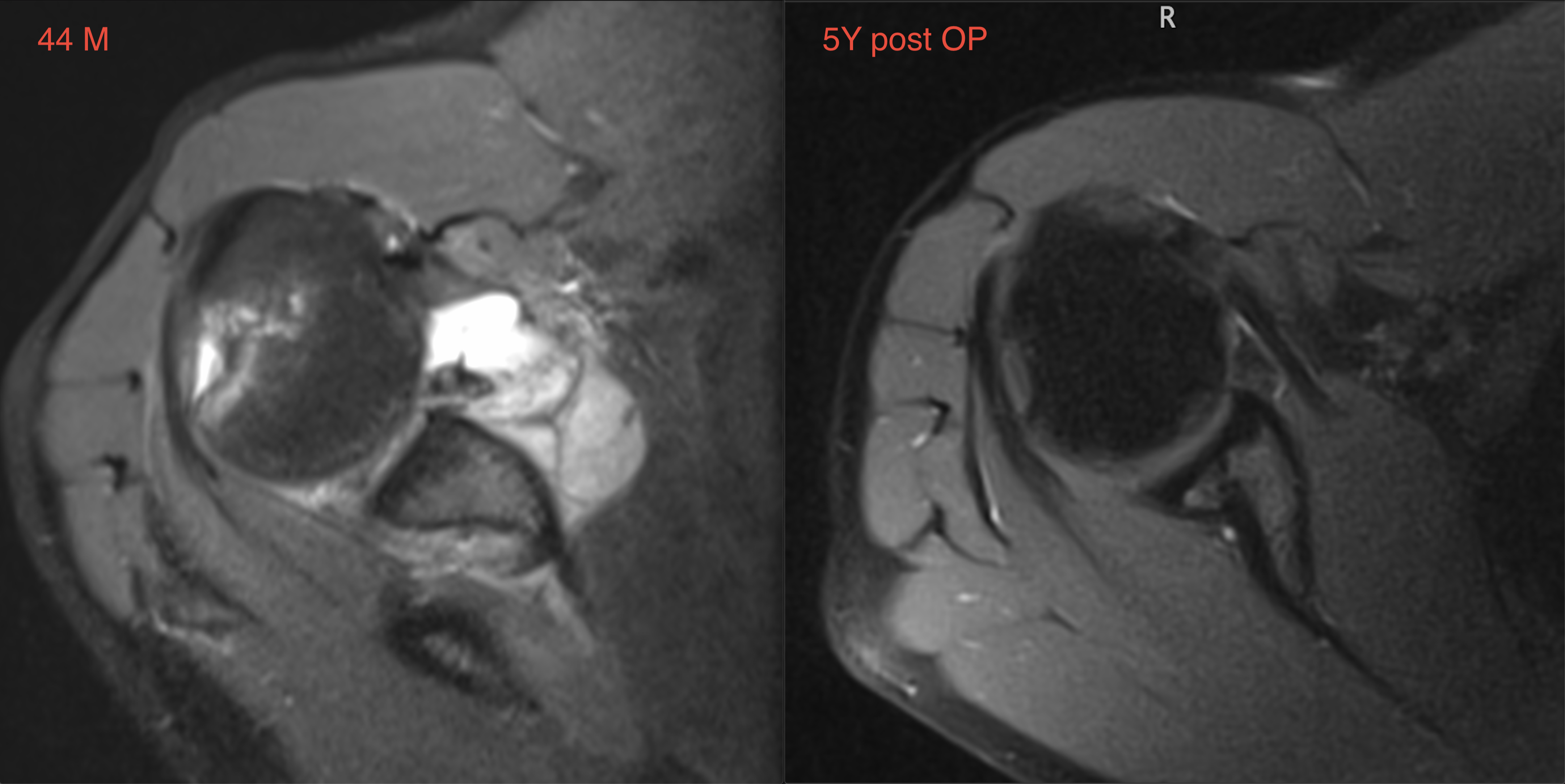
Impingement syndrome (Impingementsyndrome) is included in the indications for regenerative therapy technology, particularly effective at stages I–II and as an arthroscopy supplement at stage III. regenerative therapy achieves rotator cuff tendon regeneration through ARC transplantation directly into the tendinopathy zone, where growth factors and mesenchymal stem cells restore collagen structure. Bursitis elimination uses ARC's powerful anti-inflammatory effect without cortisone — not weakening tendons. Partial tear regeneration stimulates healing without surgery. regenerative therapy micro-arthroscopy at stage III combines decompression with ARC transplantation through micro-sized instruments.
The procedure uses Sono Control Arm™ guidance (0.1 mm precision), is outpatient and without anesthesia. Ultrasound/MRI follow-up at 8–12 weeks confirms results.
Indicated for conservative failure after 3–6 months, stage III with cuff tears, and large osteophytes. Arthroscopic subacromial decompression (ASD) is the gold standard — acromial undersurface osteophyte removal (acromioplasty) and inflamed bursa resection (bursectomy) through 2–3 punctures of 5 mm. Distal clavicle resection (Mumford procedure) addresses concomitant acromioclavicular arthrosis. Rotator cuff repair through arthroscopic anchor refixation addresses partial or complete tears. German surgeons perform thousands of shoulder arthroscopies annually with same-day or next-day discharge.
| Service | Price, € | Note |
|---|---|---|
| Diagnostics (MRI + ultrasound + exam) | 2,500–4,000 | 1 day |
| regenerative therapy | on request | outpatient |
| Arthroscopic subacromial decompression | 6,000–10,000 | 1–2 days inpatient |
| Arthroscopic rotator cuff repair | 8,000–14,000 | 1–3 days inpatient |
All treatment prices in Germany.
Germany offers precise MRI, ultrasound, and injection-based diagnostics, regenerative therapy for tendon regeneration and cortisone-free inflammation elimination, world-class arthroscopic surgery, individual exercise programs from expert physiotherapists, rapid recovery at specialized clinics, and multilingual assistance. Don't let shoulder pain progress — early treatment maximizes the chance of avoiding surgery. Contact us for treatment planning.


 +49 176 17917001
Or send us a message:


