
Organization of treatment and rehabilitation in Germany.
Complete medical support.
Complete medical support.





+49 176 17917001
All departments
The hip joint — is the largest bone articulation in the body, bearing increased loads. Its tissues are subject to degenerative changes, and their risk increases with the patient's age. Pathologies are accompanied by unpleasant symptoms — pain and limited mobility. They constantly progress and require therapy. Hip joint treatment — is not always surgical intervention. In Germany, it is possible to eliminate pathologies without surgery. Patients have access to — innovative regenerative methods that do not require long-term rehabilitation in a hospital clinic.

In German clinics patients with various congenital or acquired pathologies are accepted — hip dysplasia, femoral neck fractures. All leading orthopedic clinics in Germany specialize in degenerative-dystrophic pathologies.
The most common disease in this group — is coxarthrosis, or hip joint arthrosis. The pathology can be an independent disease, but it is often accompanied by other disorders — osteochondrosis (spinal damage) and gonarthrosis (knee joint damage).
The presence of coxarthrosis can be suspected by specific symptoms — pain in the femoral bone area radiating to the groin and knee joint, stiffness, swelling, gait disturbance. The disease goes through several stages in its development.
A similar clinical picture is observed in other hip joint pathologies — arthritis, synovitis, impingement syndrome, presence of loose bodies. Treatment cannot be started without comprehensive diagnostics. Only after examination can the doctor answer whether it is possible to cope with the disease without joint replacement.

Normally, the elements of the hip joint slide freely, which ensures mobility of the articulation. This is possible due to elastic hyaline cartilage and synovial fluid that acts as a lubricant. In pathologies, its composition changes. The fluid becomes too viscous, causing the cartilage surface to dry out and crack. Cartilage is damaged during movements. Additionally, metabolism within the joint cavity deteriorates, and muscle tissue atrophy begins.
Causes of dystrophic changes in the hip joint can be previous injuries, congenital dysplasia, infectious damage (arthritis), femoral head necrosis.
Patients at risk include those with:
The probability of hip joint damage is higher if a person leads a sedentary lifestyle or, on the contrary, is subjected to increased loads. Coxarthrosis more often develops in elderly people and athletes.

The first stage of hip joint pathology diagnosis in Germany — is a conversation with the patient. The doctor assesses the visual condition of the musculoskeletal system, checks the degree of gait disturbance, muscle tissue atrophy, and mobility impairment.
Next, the doctor will analyze the images the patient has on hand. Based on the results of the X-ray examination, the specialist draws a conclusion about the degree of pathology, which plays a key role in the subsequent choice of treatment tactics.
To clarify the diagnosis, determine the degree of hip joint damage and choose treatment tactics, diagnostics in Germany is performed using instrumental methods — CT, MRI. To assess the patient's general condition, determine the presence of inflammation and readiness for intervention, laboratory blood and urine tests are prescribed.
Therapy tactics in German clinics are determined taking into account several factors. Doctors take into account the wishes of patients, but the degree of damage to joint elements is of decisive importance. If the changes are critical, then the only possible method is endoprosthetics — total or partial. An alternative to joint replacement for grade 2-3 cartilage tissue damage — is arthroscopic minimally invasive surgery in Germany.
Both methods have their drawbacks. Arthroscopy does not always lead to a positive result and often serves only as a diagnostic stage for visual assessment of the joint condition. Endoprosthetics requires intensive rehabilitation after intervention.
Thanks to innovative developments, German clinics now offer the possibility of hip joint treatment without surgery. German doctors actively use the regenerative therapy method, developed by Professor Arsen German specialists — Doctor of Medical Sciences, who has been practicing medicine for over 20 years. The abbreviation regenerative therapy stands for Micro Invasive Biological Regenerative Autogenous Reconstruction. The method is effective in 95% of musculoskeletal system damage cases.
Treatment of hip joint pathologies in Germany — is not only arthroscopy and endoprosthetics with replacement of one's own joint with an artificial prosthesis. German doctors focus on the regenerative therapy regenerative method. This approach guarantees the elimination of the cause of pain, not just smoothing of symptoms.
Under the influence of autologous concentrate, natural regeneration is triggered in the affected joint. The volumes of damaged areas are reduced. Degenerative changes are suspended. As a result, within 1-4 months the hip joint will again fully perform its functions. For comparison, recovery after endoprosthetics surgery can take 6-12 months. Treatment results in Germany can be assessed using instrumental methods — MRI or CT.
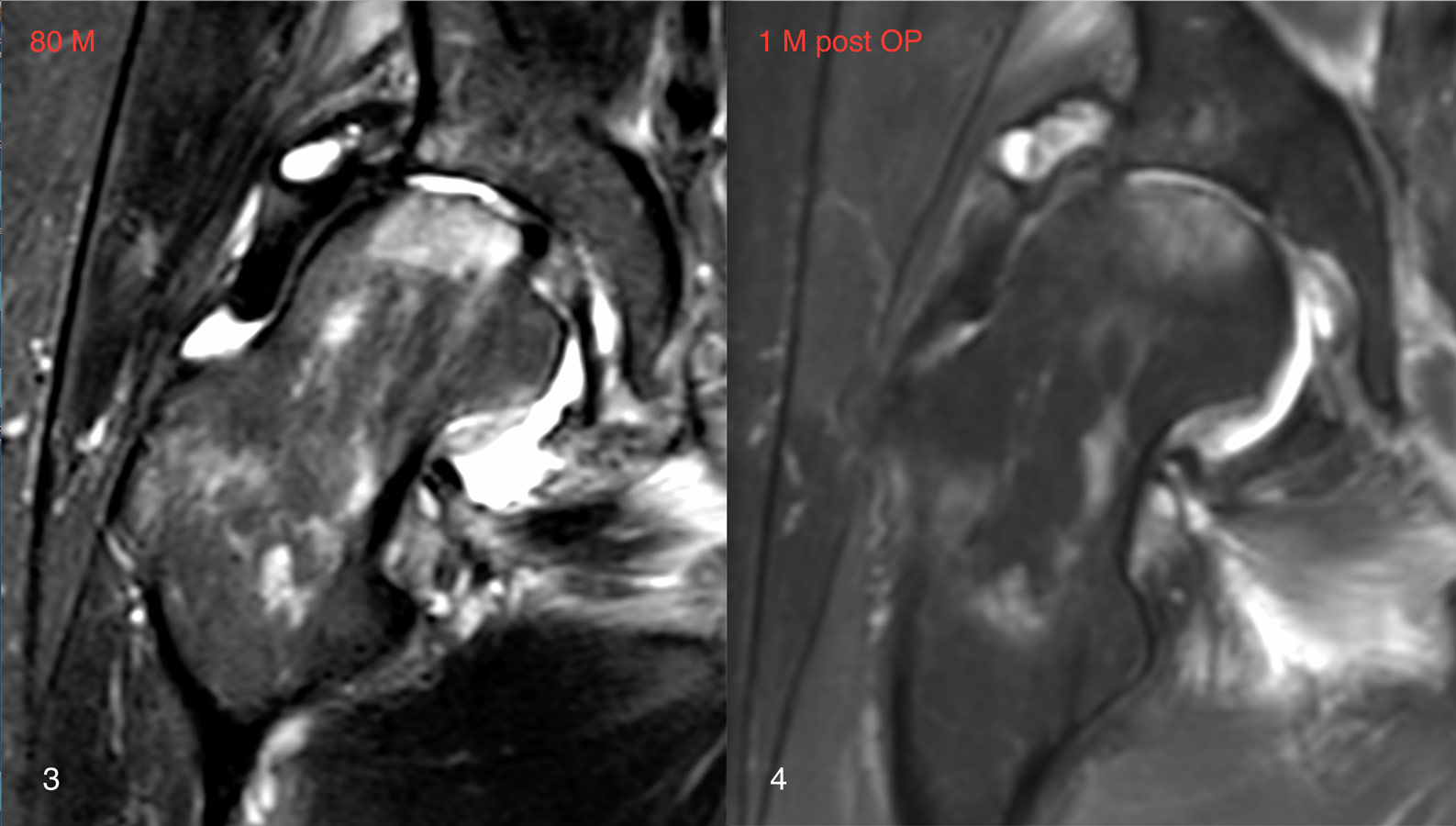
Image on the left – condition before surgery:
Stage 4 coxarthrosis. Osteonecrosis of the femoral head and neck. Synovitis.
Image on the right – 1 month after surgery:
Restoration of joint surfaces, where arthrosis and synovitis are not visualized. Signs of intensive bone tissue regeneration in necrosis areas.
Treatment in German clinics using the regenerative therapy method allows you to forget about the symptoms of hip joint diseases. The cost of therapy in Germany depends on a combination of factors. The price is affected by:
Estimated prices for treatment in Germany are given in the table below. If it is impossible to use regenerative therapy regenerative technology, the patient will be offered an alternative — endoprosthetics or minimally invasive surgery at a German clinic.
Treatment of hip joint pathologies in Germany — includes:
To choose a clinic in Germany, contact our company. We will take care of organizing your treatment. All you need to do is provide all available conclusions. We will translate the documents and send them for review to doctors in Germany.
German specialists will offer several therapy schemes, involving traditional treatment, surgery or the use of innovative technologies. You receive a preliminary cost estimate for therapy, pay the estimate and prepare for departure. Our managers will provide you with comprehensive support throughout your stay in Germany.
 +49 176 17917001

Or send us a message:


