Atlanto-Occipital Joint Arthritis Treatment in Germany
Atlanto-occipital joint arthritis (C0–C1) is degenerative damage to the articulation between the occipital bone and the first cervical vertebra (atlas). This is the uppermost spinal joint, providing nodding movements of the head. Arthritis of this joint is a common but poorly diagnosed cause of neck pain and occipital headaches. German clinics employ precise craniovertebral junction imaging methods, CT-guided blocks and innovative MIBRAR® therapy for cartilage regeneration.
What is atlanto-occipital joint arthritis
The atlanto-occipital joint (articulatio atlantooccipitalis) is a paired articulation between the occipital bone condyles (C0) and the superior articular facets of the atlas (C1). This is an ellipsoid joint providing head flexion-extension (nodding) of 25° and minimal lateral tilts. Articular surfaces are covered with hyaline cartilage and reinforced by anterior and posterior atlanto-occipital membranes.
In arthritis, cartilage thins, osteophytes form, joint space narrows. Unlike lower cervical segment arthritis, C0–C1 arthritis is often missed during standard examination, as this level is not always visualized on routine cervical spine radiographs.
Craniovertebral junction anatomy
The craniovertebral junction (CVJ) includes three levels:
Joint
Articulation
Movement
Arthritis
Atlanto-occipital (C0–C1)
Occipital bone + atlas
Nodding (25°)
Occipital pain, stiffness
Atlanto-axial (C1–C2)
Atlas + axis (dens)
Rotation (50%)
Pain on head turning
C2–C3
Axis + C3
Transition zone
Often combined with C0–C1 arthritis
Vertebral arteries, greater occipital nerve (C2), spinal cord pass near the joints. Osteophytes in arthritis can compress these structures.
Causes
Age-related degeneration — natural cartilage wear. Frequency increases after 50 years. The atlanto-occipital joint constantly bears head weight (4–5 kg).
Clinical examination — occipital region palpation, flexion-extension test, rotation test (Spurling test for C0–C1), occipital nerve assessment.
Radiography — open-mouth view (transoral projection) for atlas and axis visualization. Lateral view with functional tests (flexion/extension).
CT — bone structure detail: osteophytes, joint space narrowing, ligament calcification, developmental anomalies. Method of choice for craniovertebral junction.
Cervical collar — only during exacerbation period (no more than 2 weeks).
MIBRAR® therapy
Atlanto-occipital joint arthritis is included in the list of indications for MIBRAR® technology (individual assessment). The craniovertebral junction is one of the most complex treatment zones, requiring highest precision.
MIBRAR® for C0–C1 arthritis:
Articular cartilage regeneration — autologous regenerative concentrate (ARK), containing mesenchymal stem cells and growth factors, is transplanted into the joint under Sono Control Arm™ guidance.
Anti-inflammatory effect — ARK anti-inflammatory factors eliminate joint inflammation without cortisone, with longer and more stable effect.
Ligamentous apparatus regeneration — restoration of weakened craniovertebral junction ligaments.
Safety — Sono Control Arm™ provides 0.1 mm positioning accuracy without X-ray radiation, which is critically important for this zone (proximity of spinal cord and vertebral arteries).
Outpatient procedure, without anesthesia. Exclusively autologous material is used — without side effects and allergic reactions.
Surgical treatment
Surgical intervention is indicated for conservative therapy failure, progressive instability or spinal cord compression:
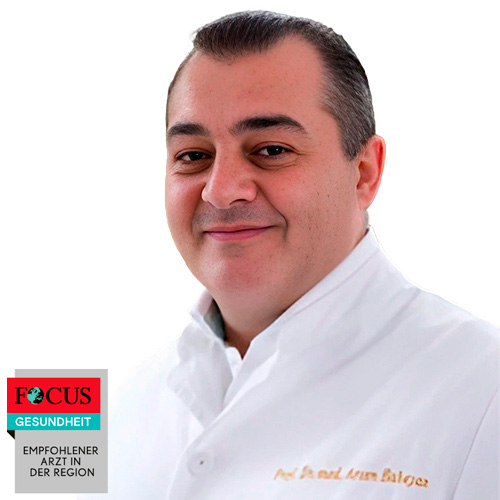
Professor Babayan's specialized center. Treatment of spine and joint diseases using the patented MIBRAR® technology — no incisions, no anesthesia, outpatient. More than 25,000 successful procedures. The world's only center offering the full range of MIBRAR® techniques.
13 специализированных лечебных центров и 3 амбулатории. Основное отделение работает в Верхней Баварии и находится в одном из самых живописных мест на берегу озера Тегернзее.
После берлинского Шарите клиника Мюнхенского университета с кампусом Инэнштадт и Гросхадерн — самый большой медицинский комплекс максимального обеспечения в Германии.
Отделение гематологии и онкологии предлагает полный спектр диагностических и терапевтических услуг в этих направлениях. Высококвалифицированная команда врачей отделения обеспечивает пациентам эффективное лечение всех онкологических заболеваний, патологий крови и лимфы (например, лейкемии, множественной миеломы)
After Berlin's Charité, the Munich University Hospital with the Innenstadt and Großhadern campus is the largest maximum care medical complex in Germany.
The Department of Hematology and Oncology offers a full range of diagnostic and therapeutic services in these fields. The highly qualified team of doctors provides patients with effective treatment of all oncological diseases, blood and lymph pathologies (e.g., leukemia, multiple myeloma).
A network of multidisciplinary clinics located in five districts of Munich. They provide a high-class range of medical services. The municipal clinics are academic clinics of both Munich universities.
The main advantages of OrthoLiga clinics are: highly qualified specialists, world-class medical care, state-of-the-art diagnostics, and comprehensive patient care.
Advantages of atlanto-occipital joint arthritis treatment in Germany
After treatment ends, within 10 days you receive the final invoice and copies of invoices from the clinic. The remaining amount is returned to the card within 3 days.
After treatment ends, within 10 days you receive the final invoice and copies of invoices from clinics. The remaining amount is returned to the card within 3 days.






 +49 176 17917001