
Organization of treatment and rehabilitation in Germany.
Complete medical support.
Complete medical support.




+49 176 17917001
All departments
Neck pain (cervicalgia) is one of the most common complaints — up to 70% of the population experiences cervical spine pain at least once. Modern lifestyle — computer work and smartphone use — exacerbates the problem. The cervical spine is the most mobile and vulnerable spinal segment, housing vertebral arteries that supply the brain and the spinal cord. Neck pain treatment in Germany is built on precise cause identification and an individualized approach: from physiotherapy to innovative regenerative therapy and minimally invasive surgery.
The cervical spine consists of 7 vertebrae (C1–C7) with unique features. It provides maximum mobility — head rotation up to 180°, tilting, flexion/extension. The atlantooccipital and atlantoaxial joints (C0–C1–C2) are unique articulations enabling nodding and head rotation — arthrosis of these joints is included in indications. Uncovertebral joints (C3–C7) are additional joints whose arthrosis leads to foraminal stenosis. Vertebral arteries pass through openings in the transverse processes and may be compressed in osteochondrosis.
Neck pain can be acute (up to 6 weeks), subacute (6–12 weeks), and chronic (over 12 weeks). Chronic cervicalgia requires a comprehensive approach.
Muscle-tonic pain from neck muscle overstrain during prolonged computer work, improper sleeping posture, or stress is the most common cause (up to 70%). Cervical osteochondrosis involves C3–C7 disc degeneration, osteophytes, and uncovertebral arthrosis. Cervical disc herniations, most commonly at C5–C6 and C6–C7, cause pain radiating to the arm — cervical radiculopathy. Facet joint arthrosis produces cervical facet syndrome with pain during extension and rotation. Cervical spinal stenosis causes myelopathy — arm and leg weakness. Whiplash injury from motor vehicle accidents damages discs, ligaments, and muscles. Cervical instability involves pathological vertebral mobility. Atlantooccipital joint arthrosis causes occipital pain and limited head rotation — included in indications.
Main symptoms include neck pain spreading to the occiput, shoulders, and interscapular area, limited head turns and tilts, headaches (occipital, temporal — cervicogenic headache), dizziness and tinnitus (with vertebral artery compression), pain, numbness and tingling in the arm (C5–C8 radiculopathy), and muscle spasms with "stiff neck."
Red flags requiring emergency evaluation: arm and leg weakness (myelopathy), gait disturbance and incoordination, urinary dysfunction, fever plus neck pain (infection suspected), and pain after trauma.
The clinical examination evaluates cervical range of motion, neurological status, and provocative tests (Spurling, distraction). Cervical MRI visualizes discs, herniations, stenosis, and the spinal cord — mandatory for radiculopathy and myelopathy. CT details bone changes including uncovertebral arthrosis, foraminal stenosis, and osteophytes. Functional radiography assesses cervical instability. Vertebral artery Doppler ultrasound evaluates vertebrobasilar insufficiency when dizziness is present. EMG is used when radiculopathy is suspected. Diagnostic facet blocks confirm cervical facet syndrome.
Drug therapy includes NSAIDs, muscle relaxants, and pregabalin for neuropathic pain. Manual therapy provides cervical mobilization — caution is essential, with only experienced specialists, and manipulation is contraindicated in instability and myelopathy. Exercise therapy strengthens deep neck flexors, provides stabilization, and stretches trapezius muscles. Ergonomics involves proper monitor height, orthopedic pillow, and breaks during computer work. Facet blocks and radiofrequency ablation address cervical facet syndrome. Epidural injections treat radiculopathy. A cervical collar should be used only briefly (3–5 days) for acute pain, as prolonged use weakens muscles.
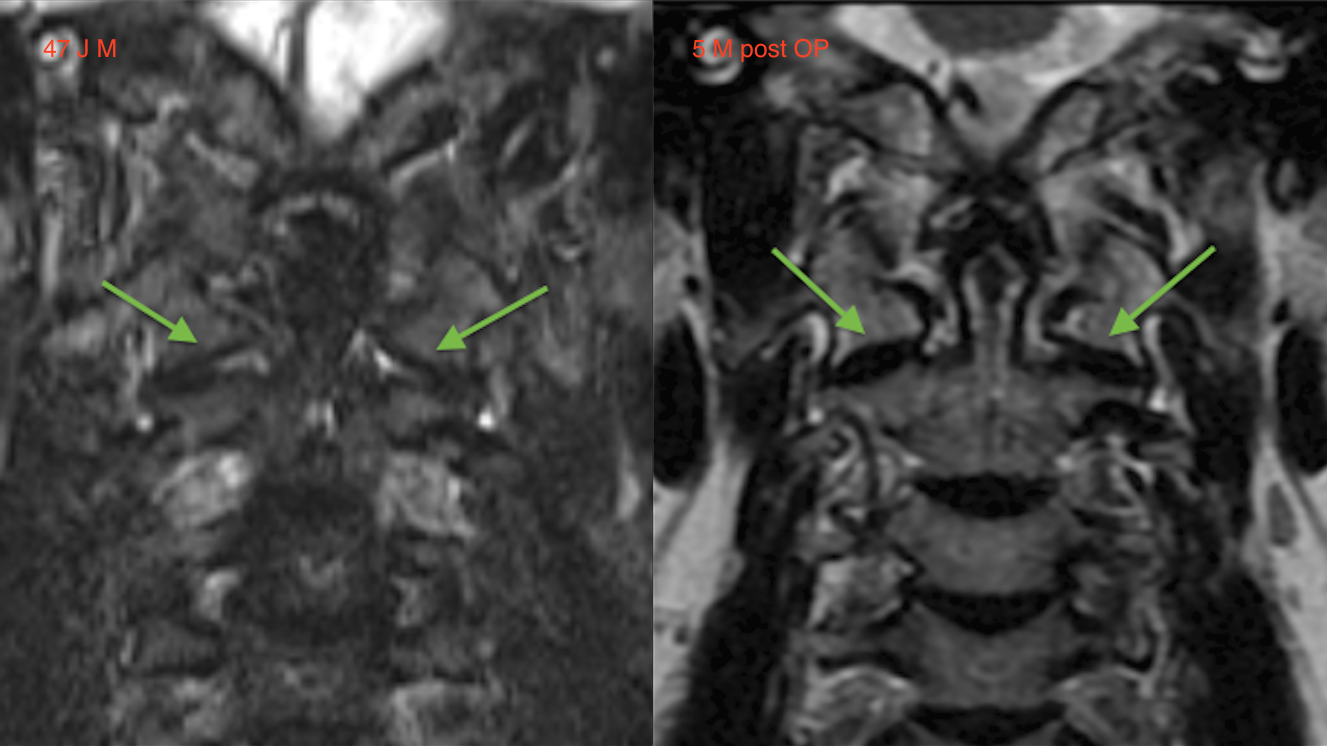
Neck pain (Nackenschmerzen) is included in the indications for regenerative therapy technology. German specialists's method is applied in all spinal regions including the cervical (HWS). For cervical disc degeneration, intradiscal ARC transplantation (RRBSW method) restores disc height and structure using a spinal probe (0.8 mm) under X-ray navigation or Sono Control Arm™ guidance. For cervical facet arthrosis, intraarticular ARC transplantation regenerates joint cartilage. For atlantooccipital joint arthrosis, targeted ARC transplantation addresses this unique indication unavailable to standard methods. For cervical radiculopathy, peridural ARC application plus disc regeneration eliminates the cause of root compression.
All cervical procedures are performed on an outpatient basis without anesthesia. The regenerative therapy navigation system ensures safety when working near the spinal cord and vertebral arteries.
Cervical surgery is indicated for myelopathy (spinal cord compression — absolute indication), progressive radiculopathy with paresis, and conservative treatment failure over 6–12 weeks. Methods include anterior cervical discectomy and fusion (ACDF — the gold standard, disc removal through an anterior approach with cage placement for decompression plus stabilization), cervical disc replacement (artificial disc preserving mobility — ideal for young patients), posterior foraminotomy (minimally invasive foramen widening for lateral herniations), and laminoplasty (canal widening for multi-level stenosis).
| Service | Price, € | Note |
|---|---|---|
| Diagnostics (MRI + examination + blocks) | 3,000–5,500 | 1–2 days |
| Conservative course | 4,000–7,000 | 7–10 days |
| regenerative therapy (cervical) | on request | outpatient |
| ACDF (1 level) | 15,000–22,000 | 3–5 days inpatient |
| Cervical disc replacement | 20,000–30,000 | 3–5 days inpatient |
All treatment prices in Germany.
Germany provides comprehensive pain cause diagnosis within 1–2 days, regenerative therapy for cervical disc and joint regeneration without surgery, unique atlantooccipital joint arthrosis treatment, minimally invasive surgery and cervical disc replacement, a multidisciplinary approach at world-class clinics, and multilingual assistance.
Don't ignore neck pain — it may signal serious pathology. Contact us for the optimal treatment plan at the best clinics in Germany.


 +49 176 17917001
Or send us a message:


