Organization of treatment and rehabilitation in Germany.
Complete medical support.
Complete medical support.





+49 176 17917001
All departments
Intervertebral disc hernia — is a pathological condition resulting from advanced osteochondrosis. In this disease, cartilage tissue undergoes dystrophic changes. It becomes thin, brittle, and under loads, part of it leaves its anatomically correct location. This is accompanied by pain and stiffness. Without timely therapy, intervertebral hernias continue to progress, which can lead to disability. Treatment of musculoskeletal pathologies in Germany — is a chance for complete restoration of mobility and elimination of all unpleasant symptoms.

The intervertebral disc — is a structure that provides movable connection of spine fragments. It consists of two main parts — the nucleus pulposus and the fibrous ring. Discs are resistant to twisting and bending, they are strong and elastic. Humans have 24 intervertebral discs in total. The largest are located in the lumbar region, and the smallest — in the cervical.
Normally, the intervertebral disc should not extend beyond bone structures. However, in some patients, osteochondrosis develops under the influence of unfavorable factors. Degenerative-dystrophic changes are triggered in the body. Cartilage tissue loses water and becomes less elastic. The height of the intervertebral disc decreases. It can no longer fully perform the function of a shock absorber. The cartilage cannot withstand the load and extends beyond the spinal column.
The development of osteochondrosis leading to hernia can be triggered by:

The development of intervertebral hernia occurs in four stages. Each stage is characterized by internal changes that inevitably progress. The clinical picture also changes. All symptoms become more intense. Detection of pathology at early stages increases the chances of successful conservative treatment.
In early stages, intervertebral disc hernia may be asymptomatic. The patient complains of rapid fatigue or heaviness in the back, but these symptoms are often mistakenly attributed to overexertion. Treatment is not provided, and the disease is detected at the second or third stage, when displaced vertebrae begin to press on nerve endings.
Main clinical signs of the disease:
Symptoms depend on the location of the pathology. When the cervical region is affected, headaches and dizziness due to impaired cerebral circulation are possible. The presence of hernia in the thoracic region provokes angina attacks and may cause dyspeptic disorders. Lumbar pathology is accompanied by severe pain when walking or bending.

Classic X-ray examination does not detect the pathology, but only indicates the presence of congenital spinal anomalies or its curvature. More informative instrumental research methods are used for hernia diagnosis in German clinics — magnetic resonance imaging and computed tomography.
The task of doctors in German clinics — is to clarify the diagnosis with which the patient arrived, determine the degree of spinal damage and the exact localization of the pathology. Based on the data obtained, an optimal treatment plan is selected.
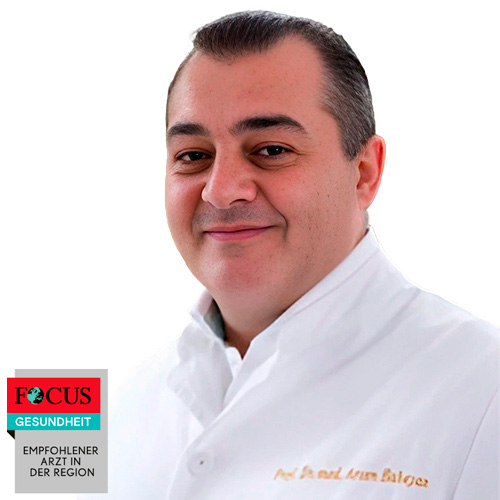
A team of experienced doctors works with each patient in Germany — surgeons, neurologists, vertebrologists. Specialists collect medical history, conduct additional diagnostics and make the final decision on therapy tactics. Preference is always given to minimally invasive and innovative methods. Spinal surgery for hernia is performed only in isolated cases when other treatment is recognized as ineffective.

Minimally invasive techniques — are treatment suitable for most patients. Their advantage — is effective elimination of unpleasant symptoms and a short recovery period. German clinics practice:
Minimally invasive methods — are the best way to cope with pain that periodically occurs when nerve endings are compressed. All methods used in German clinics have minimal contraindications and do not cause complications.

German clinics practice not only traditional vertebral endoprosthetics operations, but also modern minimally invasive intervention methods. One of them — is treatment using the MIBRAR method. This is a technique for rapid regeneration of damaged areas, providing elimination of the disease cause, not just affecting external symptoms.
The innovative MIBRAR method — is biological reconstruction based on the body's ability to self-regenerate. The patient receives a special concentrate — plasma enriched with growth factors, anti-inflammatory factors, mesenchymal cells. As a result, the process of self-restoration of cartilage tissue forming intervertebral discs is triggered.
MIBRAR treatment has its advantages compared to other hernia elimination methods:
MIBRAR treatment does not use medications or other chemical substances, so the risk of side effects is minimized. To penetrate hard-to-reach areas of the musculoskeletal system, innovative equipment is used - a micro-dimensional epiduroscope and a special device for targeted navigation – Cyber-Navi-Hand™. This is equipment with a built-in camera for monitoring the procedure progress. This tactic significantly facilitates the surgeon's work and expands their capabilities.
The result of autogenous ARF® plasma action can be evaluated in 8-16 weeks after the intervention. Positive changes will be visible on MRI or CT scans. The hernia is completely eliminated, and the volume and height of cartilage tissue are restored to normal. Destructive processes stop.
Such an effect cannot be achieved with a classic hernia removal operation. The MIBRAR system — is a new view on surgery. The intervention allows eliminating the causes of pathology, not just hiding symptoms.

If conservative treatment is not possible, doctors perform vertebral endoprosthetics. This technique allows removing affected fragments and installing artificial vertebrae in their place.
German clinics use prostheses made from materials that are well tolerated and not rejected by the body. They are flexible, mobile and durable, therefore serve for decades. The probability of successful surgical treatment of intervertebral hernia even in advanced form — is 90%.
German clinic specialists emphasize endoscopic surgery. Operations for intervertebral hernia are performed through small incisions. A camera is inserted into one of them, transmitting the image in real time to the screen.
Advantages of endoscopic spinal surgery:
The patient is allowed to get out of bed just three hours after endoscopic surgery, and the next day they can begin a course of rehabilitation procedures.

Conservative therapy is practiced in German clinics as supportive treatment. The patient receives medications that relieve pain and suppress inflammation in the presence of intervertebral hernia. The doctor may prescribe muscle relaxants, vitamin complexes, corticosteroids, chondroprotectors, non-steroidal anti-inflammatory drugs.
Drug treatment can be supplemented with physiotherapy procedures. For intervertebral hernia therapy, the following are effective:
Physiotherapy procedures in Germany are used as a supplement to minimally invasive treatment methods or as rehabilitation measures after spinal surgery. The recovery program for German clinic patients is always selected individually.


The treatment price consists of several parameters. The final cost of hernia elimination in Germany is affected by:
You can find out the cost of surgery or conservative treatment in advance before arriving at the clinic. For calculation, the patient only needs to provide all available conclusions and examination results.
Trust the choice of medical organization to professionals. Leave a consultation request and wait for our call. We will tell you which clinics in Germany specialize in musculoskeletal treatment, select a doctor and support you at all stages of therapy.
 +49 176 17917001
Or send us a message: