Organization of treatment and rehabilitation in Germany.
Complete medical support.
Complete medical support.





+49 176 17917001
All departments
The hip joint — is the largest bone articulation in the body, bearing increased loads. Its tissues are subject to degenerative changes, and their risk increases with the patient's age. Pathologies are accompanied by unpleasant symptoms — pain and limited mobility. They constantly progress and require therapy. Hip joint treatment — is not always surgical intervention. In Germany, it is possible to eliminate pathologies without surgery. Patients have access to — innovative regenerative methods that do not require long-term rehabilitation in a hospital clinic.

German clinics accept patients with various congenital or acquired pathologies — hip dysplasia, femoral neck fractures. All leading orthopedic clinics in Germany specialize in degenerative-dystrophic pathologies.
The most common disease in this group — is coxarthrosis, or hip joint arthrosis. The pathology can be an independent disease, but it is often accompanied by other disorders — osteochondrosis (spinal damage) and gonarthrosis (knee joint damage).
The presence of coxarthrosis can be suspected by specific symptoms — pain in the femoral bone area radiating to the groin and knee joint, stiffness, swelling, gait disturbance. The disease goes through several stages in its development.
A similar clinical picture is observed in other hip joint pathologies — arthritis, synovitis, impingement syndrome, presence of loose bodies. Treatment cannot be started without comprehensive diagnostics. Only after examination can the doctor answer whether it is possible to cope with the disease without joint replacement.

Normally, the elements of the hip joint slide freely, which ensures mobility of the articulation. This is possible due to elastic hyaline cartilage and synovial fluid that acts as a lubricant. In pathologies, its composition changes. The fluid becomes too viscous, causing the cartilage surface to dry out and crack. Cartilage is damaged during movements. Additionally, metabolism within the joint cavity deteriorates, and muscle tissue atrophy begins.
The probability of hip joint damage is higher if a person leads a sedentary lifestyle or, on the contrary, is subjected to increased loads. Coxarthrosis more often develops in elderly people and athletes.
The first stage of hip joint pathology diagnosis in Germany — is a conversation with the patient. The doctor assesses the visual condition of the musculoskeletal system, checks the degree of gait disturbance, muscle tissue atrophy, and mobility impairment.
Next, the doctor will analyze the images the patient has on hand. Based on the results of the X-ray examination, the specialist draws a conclusion about the degree of pathology, which plays a key role in the subsequent choice of treatment tactics.
To clarify the diagnosis, determine the degree of hip joint damage and choose treatment tactics, diagnostics in Germany is performed using instrumental methods — CT, MRI. To assess the patient's general condition, determine the presence of inflammation and readiness for intervention, laboratory blood and urine tests are prescribed.
MIBRAR — micro invasive biological regenerative autogenous reconstruction, based on the body's ability to independently restore damaged tissues.
Unlike classical medicine aimed at relieving the patient of pain syndrome, the regenerative method focuses its action on eliminating degenerative changes and deformations of hip joint segments.
MIBRAR stops negative processes and provides natural tissue regeneration and reconstruction.
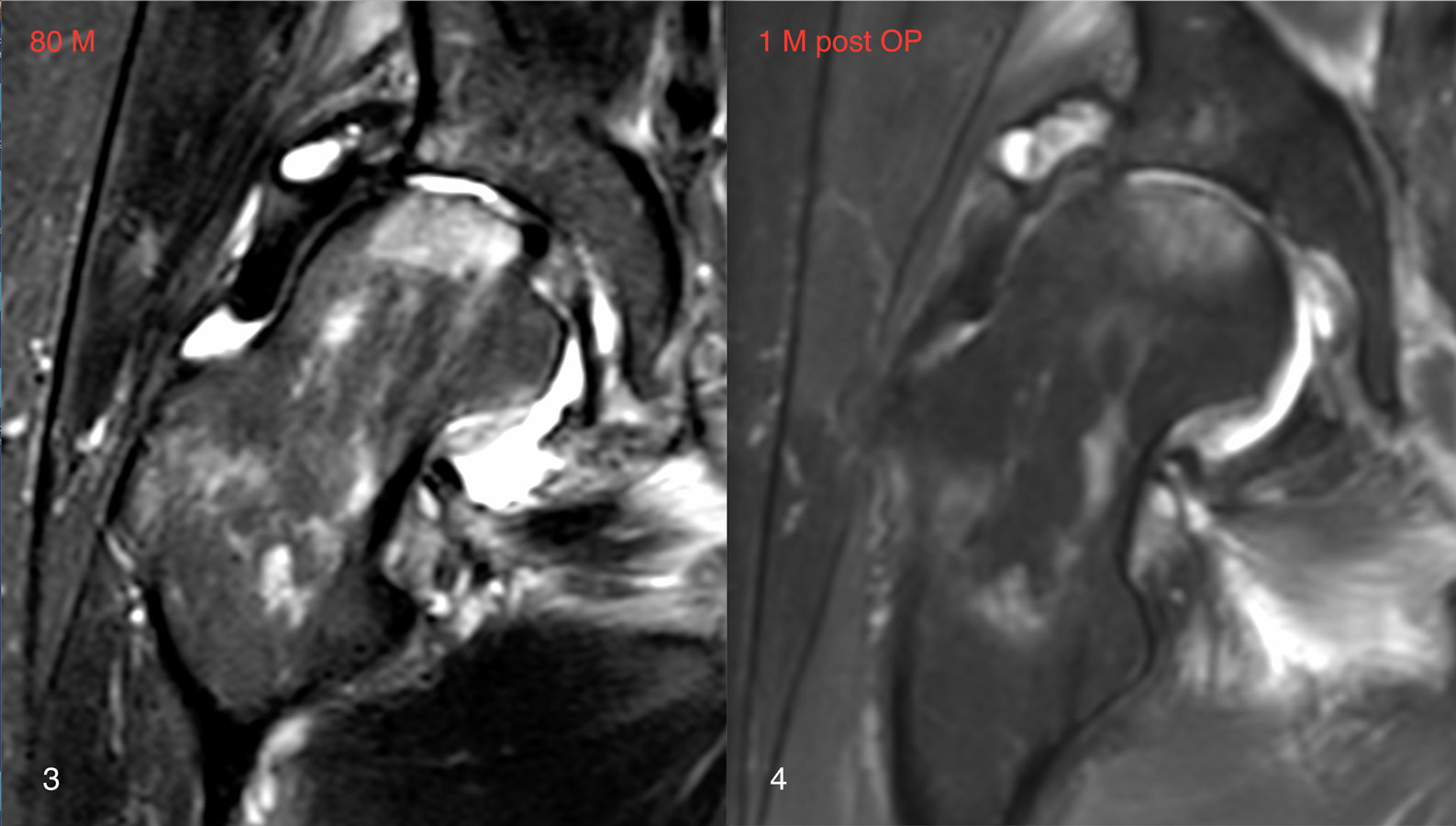
Image on the left – condition before surgery:
Stage 4 coxarthrosis. Osteonecrosis of the femoral head and neck. Synovitis.
Image on the right – 1 month after surgery:
Restoration of joint surfaces, where arthrosis and synovitis are not visualized. Signs of intensive bone tissue regeneration in necrosis areas.


 +49 176 17917001
Or send us a message: