Organization of treatment and rehabilitation in Germany.
Complete medical support.
Complete medical support.




+49 176 17917001
All departments
Lumbago ("witch's shot") is a sudden acute pain in the lumbar spine that forces the patient to freeze in a forced position. According to statistics, nearly one in three adults has experienced lumbago at some point. In Germany — where musculoskeletal disorders lead in sick days — effective lumbago treatment protocols have been developed: from rapid pain relief to eliminating degenerative causes through innovative MIBRAR® therapy.
Lumbago is not an independent disease but an acute pain syndrome in the lower back. It may present as lumbalgia (moderate aching lower back pain), lumbago proper (acute "shooting" pain blocking movement), or lumbosciatica (lower back pain radiating to the leg when a nerve root is involved). An attack typically occurs during movement — bending, lifting weights, sudden turning. The pain is so intense that the patient cannot straighten up and is forced to remain in a bent position.
Behind every acute "shot" lies a specific cause. Disc degeneration with microcracks in the annulus fibrosus irritating disc pain receptors is the most common hidden cause. Disc protrusion or herniation with root irritation or compression is another frequent trigger. Facet joint blockade from meniscoid (capsular fold) entrapment causes acute locking. Muscle spasm represents reflexive paravertebral muscle tightening in response to irritation. Segment instability with vertebral "subluxation" during movement, spondylolisthesis with vertebral displacement, and sacroiliac joint dysfunction (a common and underrecognized cause) round out the picture.
Risk factors: sedentary lifestyle, weak muscular corset, excess weight, smoking, heavy physical labor, hypothermia, and stress.
| Sign | Lumbago | Lumbosciatica |
|---|---|---|
| Location | Lower back | Lower back + buttock + leg |
| Character | Acute, "shooting" | Burning, shooting down the leg |
| Numbness | No | Yes (shin, foot) |
| Leg weakness | No | Possible (foot drop) |
| Cause | Disc, facets, muscles | Nerve root compression |
Warning! If urinary dysfunction, perineal numbness, or progressive leg weakness accompany the pain — emergency evaluation is required!
The clinical examination evaluates range of motion, muscle spasm, neurological status, the Lasègue test, and sacroiliac joint palpation. Lumbar MRI is mandatory for first-episode lumbago in patients over 50, leg radiation, neurological symptoms, and absence of improvement after 4–6 weeks. Radiography excludes fractures and spondylolisthesis. Laboratory tests (ESR, CRP) are ordered when spondylodiscitis is suspected. Diagnostic blocks — facet, root, and sacroiliac joint — determine the pain source.
The goal is rapid pain relief and mobility restoration. NSAIDs (ibuprofen, diclofenac, celecoxib) form the basis of pain management. Muscle relaxants (tizanidine, tolperisone) relieve muscle spasm. Early activation is crucial — bed rest has been proven to worsen prognosis! Walking as tolerated from the first day is recommended. Local heat application to the lower back provides comfort. For severe pain, a single epidural injection or block provides rapid relief. In most cases, acute lumbago resolves within 2–4 weeks. But if pain recurs, the cause must be identified and treated.
For recurring episodes or pain lasting over 12 weeks, exercise therapy is the key component — strengthening deep spinal stabilizers, stretching, and aerobic exercise. Manual therapy mobilizes blocked segments. Cognitive behavioral therapy overcomes kinesiophobia (fear of movement). Interventional methods include facet blocks and radiofrequency ablation for facet syndrome, and epidural injections for radiculopathy. Aquatic gymnastics and balneotherapy unload the spine.
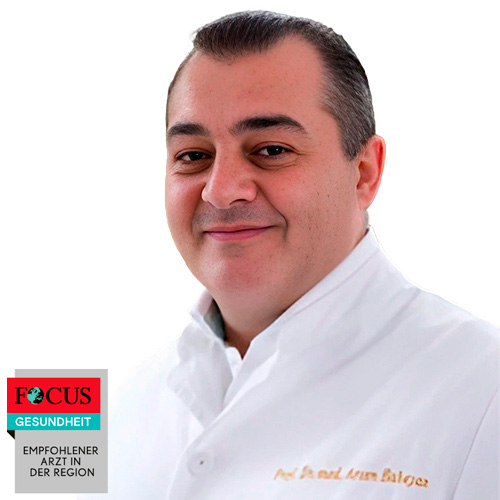
Lumbago is included in the indications for MIBRAR® technology. Prof. Babayan's method addresses the deep causes of recurrent lumbago: disc degeneration (intradiscal ARC transplantation restores disc structure, eliminating micro-instability), facet joint arthrosis (joint cartilage regeneration), instability (segment strengthening through disc and ligament regeneration), and anti-inflammatory effect (ARC contains powerful anti-inflammatory factors acting without cortisone or medications).
The procedure is outpatient, without anesthesia or incisions. Only autologous material (blood + adipose tissue) is used. MRI follow-up at 3–4 months confirms the result. Over 5,000 MIBRAR® operations have been performed with consistently high outcomes: 95% of patients report significant improvement.
Regular physical exercise strengthening back and abdominal muscles, proper weight-lifting technique (squat rather than bend), workstation ergonomics with proper chair height and hourly breaks, weight control, smoking cessation, a medium-firm orthopedic mattress, and swimming as the ideal spinal exercise all help prevent recurrence.
| Service | Price, € | Note |
|---|---|---|
| Diagnostics (MRI + examination) | 2,500–4,500 | 1 day |
| Acute attack relief (blocks) | 1,500–3,000 | outpatient |
| MIBRAR® therapy | on request | outpatient |
| Comprehensive rehabilitation (2 wks) | 5,000–10,000 | inpatient/outpatient |
All treatment prices in Germany.
Germany provides rapid pain relief through modern interventional methods, accurate recurrence cause identification through diagnostic blocks, MIBRAR® therapy eliminating degenerative lumbago causes, evidence-based rehabilitation with a comprehensive approach, multidisciplinary clinics of world renown, and multilingual assistance.
Lumbago is not "just a twinge" — it signals spinal problems. Contact us — we will not only relieve the pain but eliminate its cause.


 +49 176 17917001
Or send us a message: